 1/2
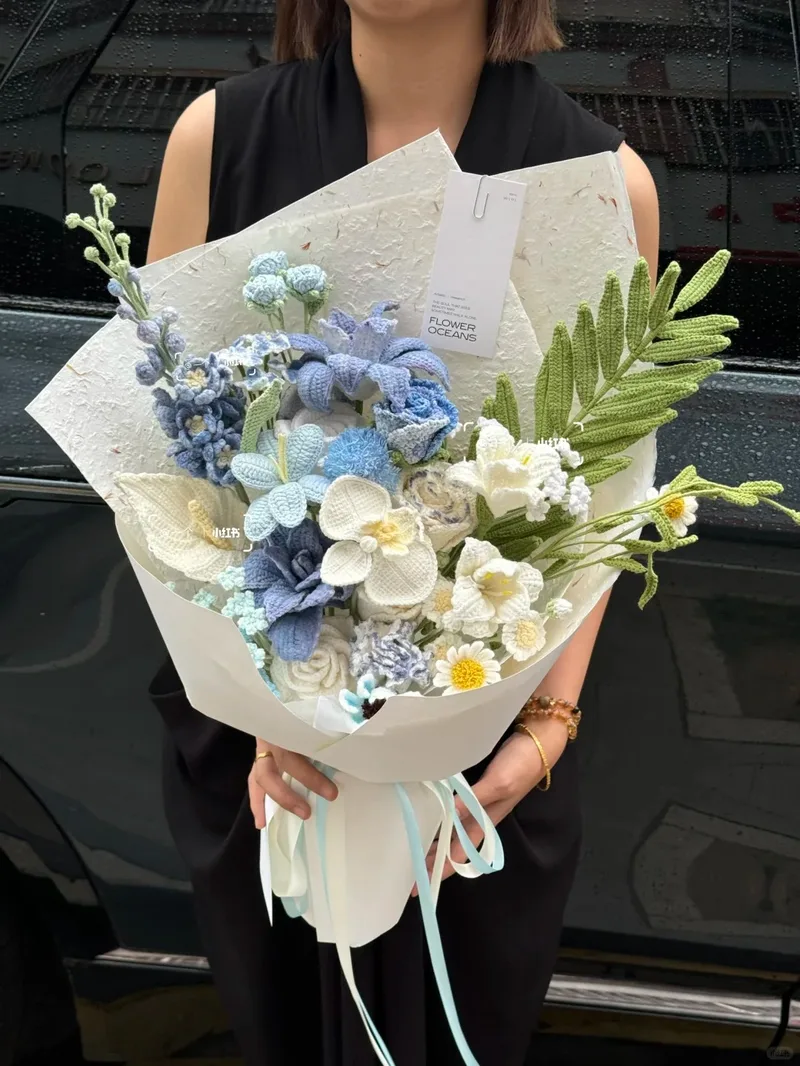
Blue Crochet Flower Bouquet
Original design by @一个
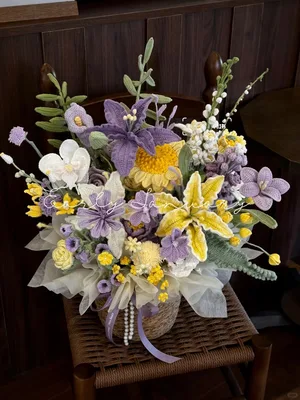
A full blue-and-white crocheted bouquet with nine different flower and foliage patterns, from areca palm fronds to roses, tulips, delphiniums and carnations. Every stem is worked around floral wire so it can be arranged and will never wilt.
- Difficulty
- Intermediate
- Time
- 10+ hours
Materials
- Cotton yarn in blue, white and green shadesAmazon ↗
- Floral wireAmazon ↗
- Floral tapeAmazon ↗
- Yarn needleAmazon ↗
As an Amazon Associate, Hooklore earns from qualifying purchases. Links open Amazon — a matching product or search results.
Stitches used: MR, ch, sc, hdc, dc, tr, dtr, sl st, inc, dec, picot
Areca Palm Frond — Six Leaf Sizes

Abbreviations used in this bouquet: X = sc, T = hdc, F = dc, E = tr, V = increase, A = decrease, K = skip, SL = sl st, W = 3 sts in one st, CH = chain.

Leaf A (make 3)
Row 1: Ch 20, lay floral wire along the chain, turn and work back starting in the 2nd ch from hook.
Row 2: 3 sc, 12 hdc, 3 sc, [sc, ch 3 picot, sc] at the tip, then work the second side symmetrically.

Leaf B (make 2): Ch 22; Row 2: 3 sc, 14 hdc, 3 sc, [sc, ch 3 picot, sc], mirror the other side.
Leaf C (make 4): Ch 26; Row 2: 3 sc, 3 hdc, 12 dc, 3 hdc, 3 sc, [sc, ch 3 picot, sc], mirror.
Leaf D (make 8): Ch 30; Row 2: 4 sc, 2 hdc, 16 dc, 3 hdc, 3 sc, [sc, ch 3 picot, sc], mirror.
Leaf E (make 4): Ch 35; Row 2: 5 sc, 4 hdc, 16 dc, 4 hdc, 4 sc, [sc, ch 3 picot, sc], mirror.
Leaf F (make 6): Ch 29; Row 2: 4 sc, 2 hdc, 15 dc, 3 hdc, 3 sc, [sc, ch 3 picot, sc], mirror.

Bundle the finished fronds along a wrapped wire stem.
Notes
Part of a blue-and-white crocheted bouquet. Each leaf is worked around a floral wire so it holds its shape. Picot = ch 3 closed at the leaf tip.
Roselle Rose — Petals and Calyx

Small petal (make 2)
Rnd 1: MR, 10 dc (10)
Rnd 2: 10 hdc inc (20)
Rnd 3: 6 sc, 8 hdc inc, 6 sc (28)

Medium petal (make 3)
Rnd 1: MR, 10 dc (10)
Rnd 2: 10 hdc inc (20)
Rnd 3: *sc, inc*, repeat 10 times (30)
Rnd 4: 2 sc, dec, 4 sc, 14x(sc, ch 2), 4 sc, dec, 2 sc

Large petal (make 5)
Rnd 1: MR, 10 dc (10)
Rnd 2: 10 hdc inc (20)
Rnd 3: *hdc, hdc inc*, repeat 10 times (30)
Rnd 4: 2 sc, dec, 4 sc, 14x(sc, ch 2), 4 sc, dec, 2 sc

Calyx
Rnd 1: MR, 20 dc (20)
Rnd 2: Ch 10, from the 2nd ch from hook work sl st, 2 sc, 2 hdc, 2 dc, 2 tr, skip 3, sl st

Roll the petals from small to large around a wire stem, smallest at the centre, and seat the calyx underneath.
Notes
V = increase (2 sts in the same stitch), A = decrease, K = skip. The ch-2 ruffle in Rnd 4 gives the petal its frilled edge.
Delphinium — Buds, Bracts and Flowers

Large bud (make 3)
Rnd 1: MR, ch 2, 10 dc in the ring
Rnd 2: Ch 2, 10 dc
Rnd 3: 5 dec (5)

Medium bud (make 3)
Rnd 1: MR, ch 2, 10 dc in the ring
Rnd 2: 5 dec (5)

Large bract (make 3): Into a magic ring work 8 unfinished dc (9 loops on the hook), yarn over and draw through all loops, sl st, fasten off.
Small bract (make 9): Into a magic ring work 5 unfinished dc (6 loops), yarn over and draw through all loops, sl st, fasten off.

Small flower (make 3)
Rnd 1: MR, 10 sc. Ch 6, picking up the back bumps and starting from the 2nd ch: 2 unfinished dc, 2 unfinished sc, pick up 1 loop in the next st, then close the loops two at a time.
Rnd 2: Ch 2, sl st into the back bump of the 2nd ch, ch 2, 2 dc, hdc, sc (sl st in the same st), sl st. 5 petals in total.

Large flower (make 6)
Layer 1: worked exactly as the small flower above.
Layer 2: Sl st to the middle of a petal and work into the outer loop, offsetting from layer 1.
Rnd 1: Ch 7, picking up the back bumps and starting from the 2nd ch: 3 unfinished dc, 2 unfinished sc, pick up the far half loop of the next st, close two at a time.
Rnd 2: Ch 2, sl st into the back bump of the 2nd ch, ch 2, 3 dc, hdc, sc (sl st in the same st), sl st. 5 petals in total.

Flower centre (make 9): Into a magic ring work (ch 6, sl st) 5 times. Fold a yarn-wrapped wire in half and pass it through the centre.
Notes
Each delphinium stem carries buds, bracts and two-layer flowers. Layer 2 petals are deliberately offset from layer 1 so the bloom looks full.
Tulip — Small and Large Petals

Small petal (make 3)
Row 1: Ch 13; starting in the 2nd ch from hook work sl st, sc, hdc, 6 dc, hdc, sc, sl st, then sc, hdc, 6 dc, hdc, sc, sl st (two lobes on one chain).
Row 2: Lay a floral wire along the edge and work a round of sc all the way around the petal, enclosing the wire.

Large petal (make 3)
Row 1: Ch 15; starting in the 2nd ch from hook work sl st, sc, hdc, 8 dc, hdc, sc, sl st, then sc, hdc, 8 dc, hdc, sc, sl st.
Row 2: Lay a floral wire along the edge and work a round of sc around the petal.

Cup the large petals around the small ones and bind the wires into a stem.
Notes
The wire edging is what lets the tulip petals be bent into a cup shape. T = hdc, F = dc in this pattern's shorthand.
One-Piece Rose — Continuous Petal Strip

Base: Ch 56, then work 53 dc starting in the 4th ch from hook.

Large petals (work 5)
Ch 2, turn. *5 dc, ch 2, turn, 5 dc inc, ch 2, turn, 2 dc inc, 2 tr inc, (tr inc, dtr, ch picot), (dtr, tr inc), 2 tr inc, 2 dc inc, then 2x(ch 2, sl st) with the last two sl sts worked into the side of the petal*, repeat 5 times.

Medium petals (work 4)
*4 dc, ch 2, turn, 4 dc inc, ch 2, turn, dc inc, dc+tr, tr inc, (tr, 2 dtr, ch 2 picot), (2 dtr, tr), tr inc, tr+dc, dc inc, 2x(ch 2, sl st) into the side of the petal*, repeat 4 times.

Small petals (work 4)
*3 hdc, ch 2, turn, 3 dc inc, ch 2, turn, hdc inc, 4x(dc inc), hdc inc, 2x(ch 2, sl st) into the side of the petal*, repeat 4 times.

Roll the finished strip from the small-petal end inwards and stitch the base to hold the rose shape.
Notes
Worked as a single continuous strip that is rolled into a rose. Shorthand: F = dc, T = hdc, E = tr, G = dtr, V = increase; combinations such as FV/TV/EV mean an increase in that stitch.
Carnation — Ruffled Flower and Calyx

Flower
Rnd 1: MR, 12 dc (12)
Rnds 2-3: 12 dc each round (12)
Rnd 4: 3 dc in each st around (36)
Rnd 5: 3 dc in each st around (108)
Rnd 6: *sc, ch 3*, repeat 108 times around for the frilled edge

Calyx
Rnd 1: MR, 6 sc (6)
Rnd 2: 6 inc (12)
Rnds 3-7: 12 sc each round (12)
Rnd 8: *3 sc, inc*, repeat 3 times (15)
Rnd 9: *ch 3, dc dec, sl st, ch 3, sl st*, repeat 5 times to form the pointed sepals

Gather the flower, insert a wire stem and seat the calyx underneath.
Notes
FW = 3 dc worked into one stitch, which is what makes the carnation double in width twice and ruffle. FA = dc decrease. The Rnd 9 symbol read as a slip stitch; work the sepal points to taste.
Galsang Cosmos Flower — One-Piece Calyx and Petals

Rnd 1: With calyx colour, MR, 8 sc (8)
Rnd 2: 8 sc (8)
Rnd 3: *Ch 5, from the 2nd ch from hook work 4 sl st back along the chain, then sl st into the outer loop of the next st*, repeat 8 times
Rnd 4: Change to flower colour. 8 sc in the front loops, sl st
Rnd 5 (petals, repeat the whole group 8 times):
  Ch 8, working into the back bumps from the 1st ch make 7 unfinished sc; turn the work and make 1 more unfinished sc into the sl st of Rnd 4; yarn over and close the loops two at a time.
  Ch 2, sl st into the back bump of the 2nd ch, ch 1, pick up the back bumps and make 5 unfinished sc, close two at a time.
  Ch 2, sl st into the back bump of the 2nd ch, ch 1, pick up the back bumps and make 7 unfinished sc, close two at a time.
  Ch 2, sl st into the back bump of the 2nd ch, 7 sl st along the back bumps, sl st into the next stitch.

Note: the work only needs to be turned for the first petal group.
Notes
Afghan-style one-piece construction: the calyx and all 8 petals are worked without cutting the yarn. The unfinished-sc bundles closed two at a time are what shape each petal.
Goblet Rose — Three Petal Sizes

Small petal (make 3)
Rnd 1: 6 sc in MR (6)
Rnd 2: 6 inc (12)
Rnd 3: *sc, inc*, x6 (18)
Rnd 4: *2 sc, inc*, x6 (24)
Rnd 5: *3 sc, inc*, x6 (30)
Rnd 6: *4 sc, inc*, x6 (36)
Rnd 7: 10 sc, 3x(4 sc, inc), inc, 10 sc
Rnd 8: 10 sc, 3x(5 sc, inc), inc, 11 sc
Rnd 9: 11 sc, 3x(6 sc, inc), inc, 11 sc

Medium petal (make 3): Work Rnds 1-9 as above, then
Rnd 10: 11 sc, inc, 3 sc, (sc, ch 1, sc), 3 sc, inc, 3 sc, (sc, ch 2, sc), 3 sc, inc, 3 sc, (sc, ch 1, sc), 3 sc, inc, 3 sc, 9 sc

Large petal (make 3): Work Rnds 1-9 as above, then
Rnd 10: 11 sc, 7x(inc, 3 sc), 9 sc
Rnd 11: 12 sc, inc, 4 sc, (sc, ch 1, sc), 4 sc, inc, 4 sc, (sc, ch 2, sc), 4 sc, inc, 4 sc, (sc, ch 1, sc), 4 sc, inc, 12 sc

Nest the petals small-to-large around a wire stem to form the goblet-shaped rose.
Notes
V = increase (2 sc in one stitch). The ch-1 and ch-2 points in the last round create the scalloped goblet rim.
Multi-Head Bubble Flower — Blossom Strip and Calyx

Blossom
Row 1: Ch 23
Row 2: Starting in the 4th ch from hook, *(3 dc), sc, skip 1 st*, repeat to the end of the chain
Row 3: *Ch 2, dc, dc inc, dc, ch 2, sc*, repeat to the end

Calyx
Rnd 1: MR, 5 sc (5)
Rnd 2: 5 inc (10)
Rnd 3: *Ch 5, from the 2nd ch from hook sl st, sc, hdc, skip 1 st and sl st*, repeat 5 times

Roll the blossom strip into a cluster of small bubble flowers and seat the calyx underneath on a wire stem.
Notes
K = skip a stitch. The strip construction gives several small blooms on one stem, hence 'multi-head'.
Frequently asked questions
What do the letters in the original charts mean?
This set uses Chinese shorthand: X is single crochet, T is half double crochet, F is double crochet, E is treble, G is double treble, V means an increase, A means a decrease, K means skip, SL is a slip stitch and W is three stitches worked into one.
Why is floral wire worked into the pieces?
Leaves and petals are crocheted around a length of wire so they hold a bent shape. Without the wire the pieces are floppy and the bouquet will not hold its arrangement.
Which flower should I start with?
The goblet rose and the multi-head bubble flower are the simplest, being plain single crochet spirals and a rolled strip. The one-piece rose and the galsang cosmos are the most demanding because they are worked as a single continuous piece.
How many pieces make one bouquet?
The palm fronds alone call for 27 leaves across six sizes, plus multiple petals per flower. Make the foliage first so you can judge how many blooms the bouquet needs.